
How can cities move shared mobility beyond pilots and make it deliver lasting public value? This was the central question explored during Special Interest Session 37 at the ITS European Congress, where SUM brought together city representatives, mobility practitioners, researchers, and industry experts to exchange practical lessons from implementation.
Organized by SUM project partners, ERTICO, and moderated by Fernando Gramaglia, from Mobility Impact Market, the session focused on one of the key challenges facing urban mobility today: how shared mobility services can better support public policy objectives such as modal shift, accessibility, inclusion, and sustainability.
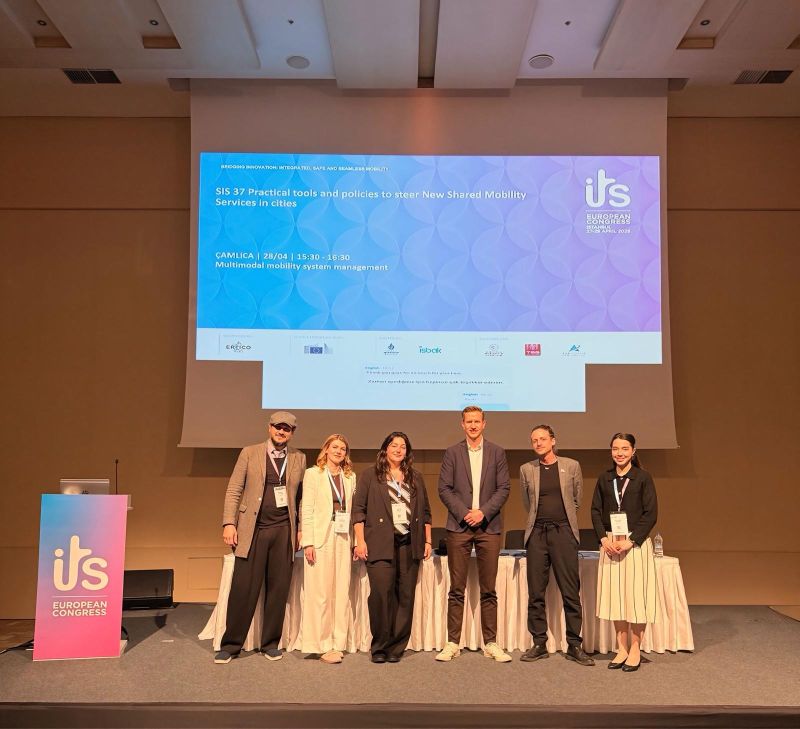
Learning from cities putting shared mobility into practice
A central part of the discussion focused on how cities are integrating shared mobility into their transport systems through mobility hubs, digital platforms, and stronger governance frameworks.
In the West Midlands, regional authorities presented their Local Travel Points initiative, a growing network of mobility hubs designed to connect public transport, shared mobility, and active travel services at neighbourhood level. The initiative combines physical infrastructure with digital tools and sensor-based monitoring to better understand how people move through public space and how hubs can respond to local travel patterns.
From Hamburg, participants shared lessons from the city’s long-term strategy to integrate shared mobility into everyday urban travel. Through its MaaS platform MAX and the rollout of more than 200 mobility stations across the city, Hamburg is creating an ecosystem where public transport, shared bikes, scooters, and other mobility services can be accessed through one digital interface. The city also uses dedicated digital dashboards to monitor e-scooter operations and reduce street clutter, showing how regulation and technology can work together.
Shared learning across European innovation projects
The session also highlighted lessons from ongoing European innovation projects.
The BABLE Smart Cities team shared experiences from the metaCCAZE project, which supports cities in accelerating the deployment of zero-emission mobility and digital urban solutions. The project demonstrates how cross-city collaboration and structured knowledge exchange can help local authorities scale innovation more effectively.
The SUM Open Data Platform was presented by the project coordinator INRIA as a tool designed to help cities better understand the impact of shared mobility measures over time. By providing access to harmonised indicators such as modal split, service performance, and policy outcomes, the platform supports benchmarking, peer learning, and more evidence-based urban mobility planning.
New approaches to funding and public value
Beyond infrastructure and technology, the discussion also explored new ways of funding and procuring shared mobility services.
Examples from the private and investment sector showed how outcome-based procurement models can help cities move away from simply buying services towards funding measurable public outcomes, such as reduced emissions, increased accessibility, or higher public transport integration.
Participants also acknowledged the operational challenges cities continue to face, including fragmented budgets, limited public space, and the need for stronger coordination between transport, planning, and digital departments.
Aligning policy, data, and implementation
Across all contributions, one message stood out: shared mobility only creates lasting public value when policy frameworks, data systems, and funding mechanisms are aligned.
The session concluded with a clear sense that cities are no longer asking whether shared mobility has a role to play, but how to govern it effectively. By openly sharing both successes and challenges, cities and projects across Europe are helping shape the next generation of sustainable urban mobility.

