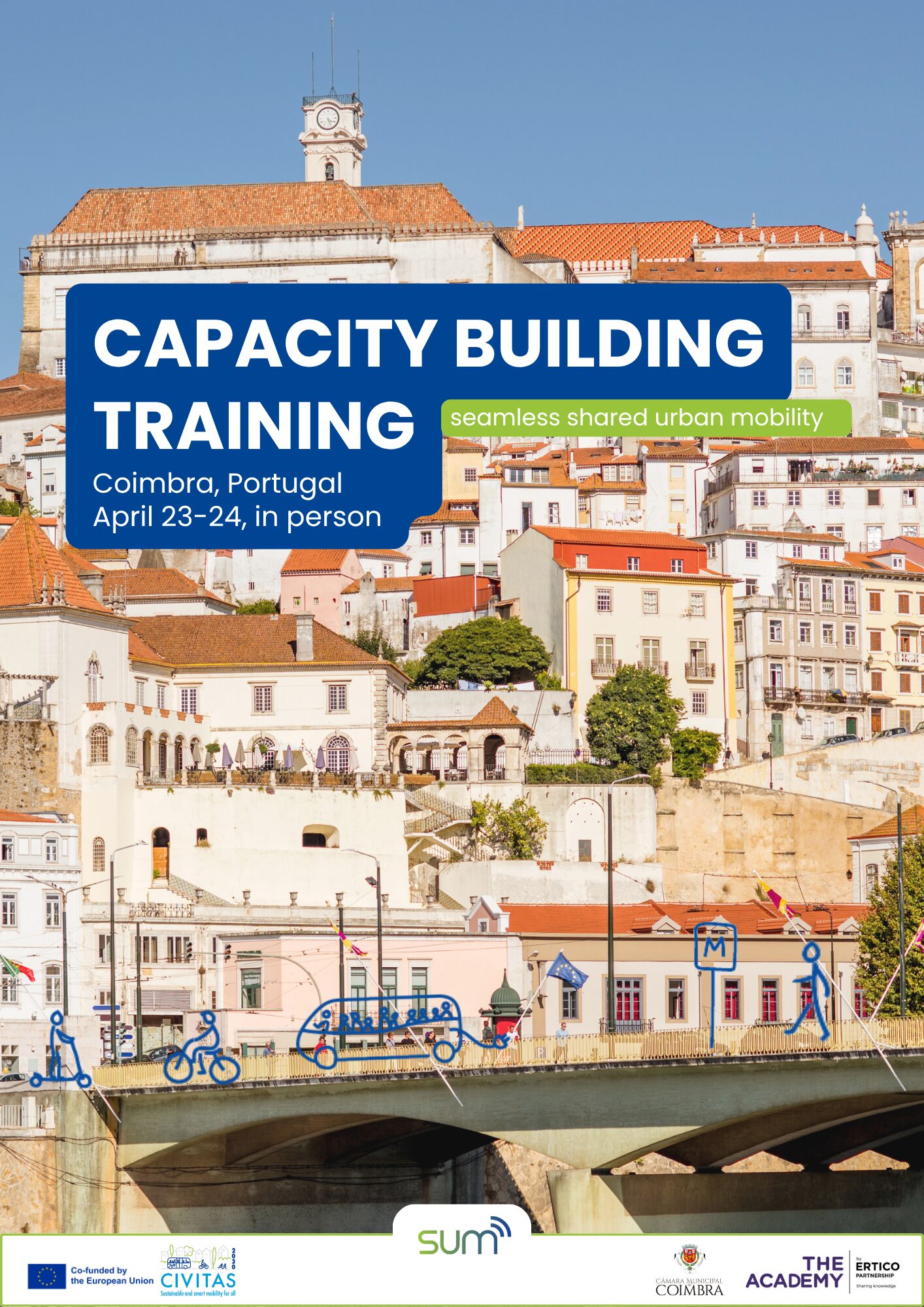
Registrations are now open for the SUM Capacity Building Training and Living Lab visit, taking place on 23–24 April 2026 in Coimbra, Portugal. The training is open to external participants, including cities, regions, transport operators, researchers, and mobility practitioners working on shared and integrated urban mobility.
The training is designed as a practice-oriented learning experience, focusing on how cities can move from ambition to implementation when deploying shared mobility solutions.
Participants will work on the development and testing of business models for sustainable mobility services, exploring how different value propositions, revenue streams, and cost structures shape the viability of services in real urban contexts. Rather than remaining theoretical, these aspects are addressed through applied exercises where participants design and refine their own mobility service concepts, working in groups and receiving feedback from peers and experts.
A central element of the training is the integration of services within the urban system. Sessions will address how mobility hubs can act as operational and spatial anchors, connecting shared mobility, public transport, and active modes. This is complemented by practical work on how these elements fit within wider planning frameworks and decision-making processes at city level.
Beyond service design, the training also tackles the often underdeveloped dimension of uptake and user behaviour. Participants will explore how to communicate mobility offers effectively, using digital tools and targeted strategies, and how to design engagement processes that involve citizens and stakeholders in a meaningful way, ensuring that services respond to real needs and gain public acceptance.
These strands are not treated in isolation. Through an integrated workshop format, participants will bring together business models, spatial planning (hubs), communication, and engagement into coherent approaches, reflecting the cross-sectoral nature of mobility planning in cities.
The training is further grounded in practice through the Coimbra Living Lab, where participants will experience local mobility solutions, including on-demand public transport and micromobility services, and engage directly with the actors responsible for their implementation.
With a maximum capacity of 20 participants, the training ensures a focused environment for exchange, collaboration, and in-depth discussion.